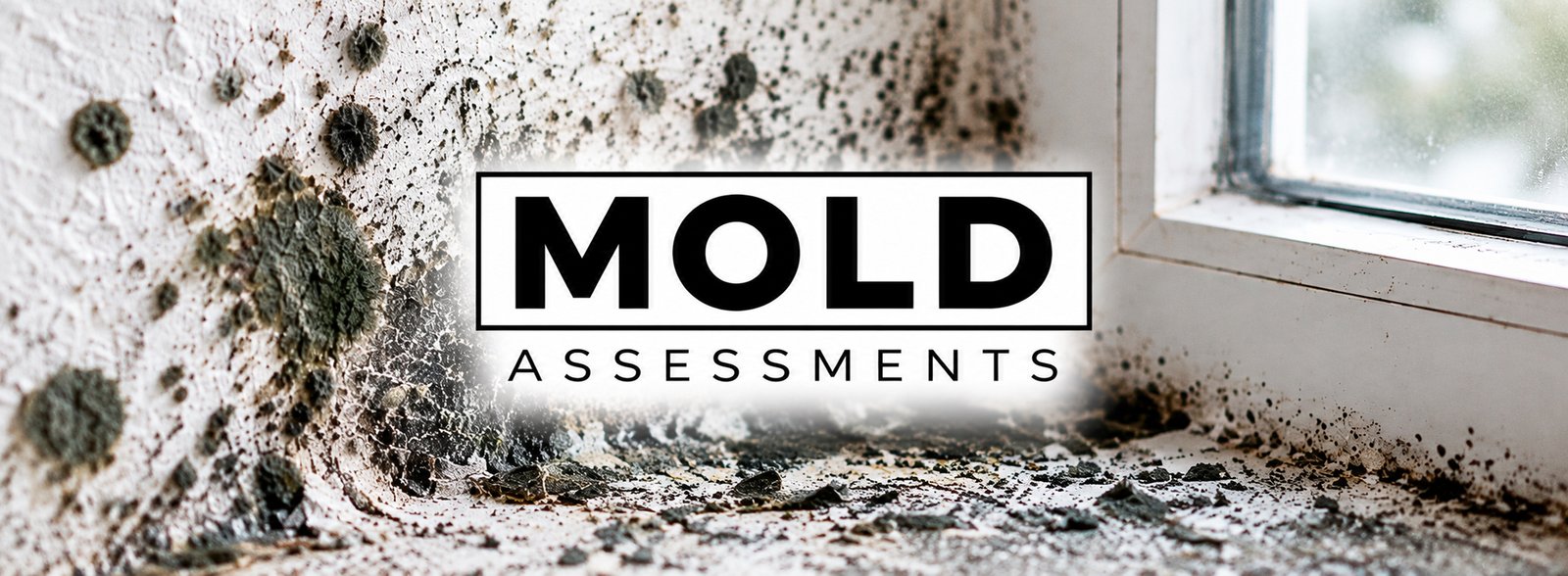








Usually, no. If you can already see mold growing indoors, you generally do not need a laboratory test simply to confirm that something needs attention. The EPA says sampling is unnecessary in most cases involving visible mold. A professional assessment may still help you understand the affected areas and plan the next step. Testing becomes useful when it answers a specific question that could change that plan.
Visible growth still needs attention, even when laboratory testing would add little.
Mold testing and a mold assessment answer different questions
Homeowners often use “inspection,” “assessment,” and “testing” interchangeably. They are related, but they are not identical.
Testing involves collecting samples for analysis. An assessment considers the concern more broadly: what is visible, which accessible areas and materials are affected, what relevant history is available, and what documentation or professional follow-up is needed.
Imagine finding growth across the back of a basement cabinet. A laboratory name alone would not tell you which surrounding materials need attention or what a cleanup contractor should include in the project.
That is why our independent mold assessment is not automatically a package of air samples. The useful starting point is the homeowner’s question and the condition of the property.
Ask what the result would change
Before agreeing to sampling, ask: “What decision will this test help us make?”
There should be a practical answer. Perhaps a questionable mark needs identification. Perhaps samples are part of established requirements for evaluating completed remediation. The collection method and interpretation should fit that purpose.
If the only answer is “to prove mold exists,” and obvious growth is already present, ask whether sampling adds anything useful.
This is also a helpful way to compare proposals. A longer list of samples is not automatically a more thorough assessment. Ask what areas are included, what the written findings will explain, and whether laboratory analysis is optional or specifically justified.
Our article on DIY tests versus professional mold testing explains the differences between testing approaches.
When sampling may still be useful
Visible growth in one location does not answer every question about a home. There are situations where an assessor may recommend targeted sampling.
One example is uncertainty about the material itself. Some discoloration is staining, dirt, or another deposit. When identifying a suspicious substance would affect the recommendation, a properly selected surface sample may help.
Another example is verification after professional cleanup, when sampling is appropriate for the project or included in its clearance criteria. That is a different purpose from taking samples simply because a homeowner has found a visible patch.
The EPA’s mold sampling guidance emphasizes professional planning and interpretation. Air samples describe conditions during the collection period; they are not a permanent description of the entire house.
A sample also cannot inspect inside every wall. Questions about concealed areas require careful professional judgment rather than assuming one air result settles everything.
A mold count is not a universal safety score
It is understandable to want a report that says “safe” or “unsafe.” Mold reports do not work that simply.
There are no EPA or other federal limits for mold or mold spores that establish a universal passing concentration for a home. A laboratory result therefore cannot demonstrate compliance with a federal mold limit that does not exist.
Results need context, including the sampling purpose and the conditions observed. An apparently reassuring result should not be used to dismiss growth that is plainly visible.
Health questions also deserve their own attention. The EPA advises consulting a health professional about mold-related health concerns. A building assessment does not diagnose an illness or determine whether mold caused someone’s symptoms.
Does every visible patch require professional cleanup?
Not necessarily. The EPA’s homeowner cleanup guidance says that, in most cases, homeowners can handle areas smaller than about 10 square feet by following its guidance.
Size is only one consideration. Significant water damage, the affected material, possible concealed growth, and individual health concerns can change the appropriate response. Contaminated water calls for experienced professional help.
Avoid treating that area guideline as a guarantee that a job is simple. Mold on a small accessible hard surface presents different questions from growth on deteriorated drywall.
Do not paint over mold to hide it, and do not start opening finished walls just to see how far it goes. Disturbing concealed growth can spread spores. If the extent is uncertain, discuss the situation before starting demolition.
Why independent assessment matters in New York
If professional remediation is the next step, the assessment and cleanup have separate roles.
The New York State Department of Labor’s mold FAQ explains that a licensed mold remediation contractor cannot perform a project without an assessment by a licensed mold assessor. It also explains the prohibition on a licensee performing both assessment and remediation on the same project.
For a homeowner, this separation helps establish a defined scope before the cleanup work begins. Our Mold Remediation Plan service provides project-specific documentation for that process. Inside Diagnostics provides independent assessment and testing; we do not perform mold remediation.
The underlying water problem still needs appropriate attention. A plumber, roofer, HVAC contractor, or another qualified specialist may be needed to investigate and repair it. Mold testing does not replace that work.
What to have ready before scheduling
A few details can make the first conversation more useful:
- Where you noticed the growth or discoloration.
- Roughly how much surface area appears affected.
- When you first noticed it and whether it has returned.
- Any known leak, flooding, or previous cleanup history.
- Photos taken without disturbing the material.
- Whether a contractor has already proposed cleanup or testing.
You do not need a mold species name before asking for help. You also do not need to disturb the area to gather better photos.
If cleanup has already happened, explain that when you call. Post-remediation verification addresses completed work and its established clearance requirements.
Get a clear next step for your home
Inside Diagnostics serves homeowners throughout Westchester, Putnam, Dutchess, Orange, and Rockland counties. Whether you have one questionable patch or several affected areas, the goal is to determine what assessment and documentation would be useful.
To schedule a mold assessment, call or text (914) 879-5022 with your property location and a short description of the concern.
A clear assessment can help you choose the next step without paying for tests you do not need.