



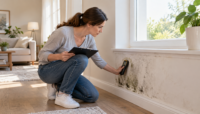
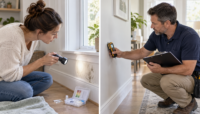
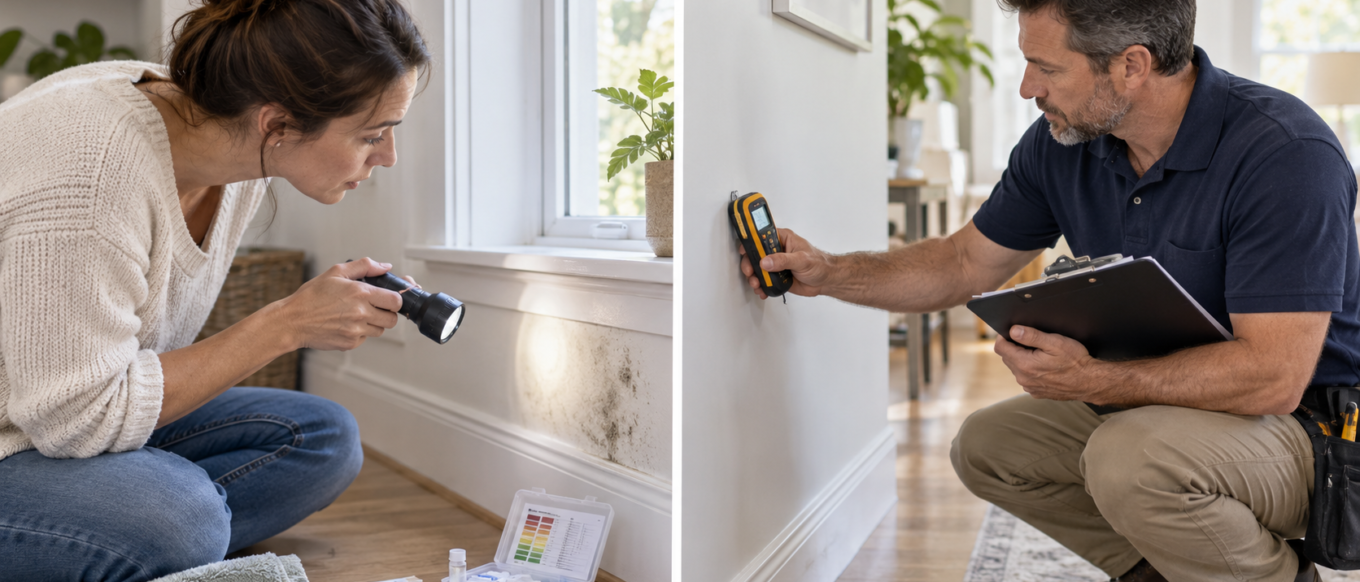
You can check your home for mold by looking for visible growth, musty odors, water stains, leaks, and damp building materials. DIY mold test kits are also available, but they have important limitations because mold spores naturally exist both indoors and outdoors. If you have visible mold, testing may not even be necessary. Professional mold testing is most useful when the source is unclear, hidden mold is suspected, or you need an independent assessment of a larger moisture problem.
Start With the House, Not a Mold Test Kit
If you suspect mold, your first step does not need to be ordering an air-testing kit.
Start by looking for moisture.
Mold needs moisture to grow, so the most useful clues are often fairly ordinary things: a plumbing leak, a damp basement, water staining around a window, condensation, a roof leak, or an area that simply never seems to dry completely.
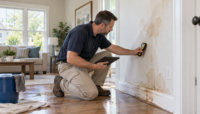
Walk through the home and pay particular attention to:
- Basements and crawl spaces
- Areas around plumbing fixtures
- Bathrooms
- Laundry rooms
- Areas below windows
- Ceilings below bathrooms
- Areas with previous roof leaks
- Around air-conditioning equipment
- Walls or flooring affected by previous water damage
A persistent musty odor is also worth investigating, especially if you cannot immediately see where it is coming from.
You are not necessarily trying to identify the exact species of mold. At this stage, you are trying to answer a simpler question:
Is there evidence of a moisture problem or mold growth that needs further investigation?
Can I Use a DIY Mold Test Kit?
You can, but understand what you are buying.
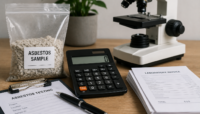
Many DIY mold tests use a small petri dish that is left open in a room for a period of time. Other kits allow you to collect a surface sample and send it to a laboratory.
The problem with the petri-dish approach is that mold spores are a normal part of our environment. They are found outdoors and can enter homes through doors, windows, ventilation, clothing, shoes, and normal air movement.
That means getting something to grow on a DIY test does not automatically mean you have an unusual mold problem.
In fact, the EPA notes that there are no federal standards defining an acceptable concentration of airborne mold spores. A test result therefore cannot simply be compared with an EPA number that says your home has “passed” or “failed.”
That is one of the biggest limitations of inexpensive home mold tests.
They may tell you mold is present.
They usually do not tell you why it is present, where it is growing, how extensive the problem is, or what needs to be corrected.
What About Surface Mold Tests?
Surface testing can sometimes provide more useful information.
For example, you may find unusual discoloration on a building material and want to know whether it is actually fungal growth or simply dirt, staining, or another material.
A properly collected surface sample analyzed by a laboratory can help answer that question.
But even then, the test does not replace investigating the surrounding area.
If mold is growing on drywall because a pipe has been leaking inside the wall, identifying the mold does not solve the important part of the problem. You still need to find the leak and determine how much material has been affected.
The EPA makes the same general point: the key to controlling indoor mold is controlling moisture.
Do I Need to Test Visible Mold?
Usually, no.
If you can clearly see mold growth and you already know there has been a moisture problem, laboratory testing may not change what needs to happen next.
For example, imagine that a basement wall became wet after repeated water intrusion and now has obvious mold growth.
Sending a sample to a laboratory may tell you what types of mold were collected, but you already know the two most important facts:
There is mold growth.
There is a moisture problem.
The EPA specifically states that when visible mold growth is present, sampling is generally unnecessary.
The better use of time and money may be determining why the wall is getting wet, how far the damage extends, and what needs to be cleaned or removed.
When Does Professional Mold Testing Make Sense?
There are situations where professional testing can be useful.
One example is when you repeatedly smell a musty odor but cannot find visible mold.
Another is when a building has experienced water damage and there is concern about hidden areas behind walls, below flooring, or around other building materials.
Testing may also be considered when different areas of a home need to be compared or when additional documentation is needed.
A professional assessment may involve more than sampling. Depending on the situation, the assessor may inspect accessible building materials, take moisture readings, document areas of concern, investigate previous water damage, and determine whether collecting samples would actually answer a useful question.
That last part is important.
Professional mold testing should not simply mean taking as many samples as possible.
There should be a reason for each sample.
How Does Professional Air Sampling Work?
One method of professional mold testing involves collecting measured volumes of air onto specialized sampling media.
The samples are then analyzed by a laboratory.
An outdoor sample may also be collected so the assessor can evaluate indoor findings in the context of outdoor conditions.
But professional air sampling still has limitations.
Airborne mold levels can change with weather, ventilation, HVAC operation, activity inside the house, and other conditions. An air sample represents conditions during the period when the sample was collected.
The EPA specifically cautions that air sampling provides information about the moment when sampling occurred and that results can be difficult to interpret without experience.
That is why the inspection of the building is just as important as the laboratory report.
Should I Buy a Mold Detector?
There is no handheld device that you can simply point at a wall and reliably have it tell you, “This is mold.”
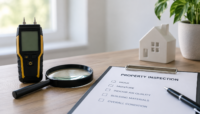
Some useful inspection tools measure conditions associated with mold growth rather than mold itself.
A moisture meter, for example, can help identify damp building materials.
A thermal camera may help locate temperature patterns that deserve closer investigation.
A hygrometer can measure indoor relative humidity.
These tools can be useful for locating moisture problems, but none of them positively identifies mold by itself.
Think of them as tools for investigating the building rather than mold detectors.
Can I Test My Own House in New York?
Yes.
New York allows residential property owners to inspect or assess their own property without obtaining a mold license.
However, if you hire someone to perform a mold assessment professionally in New York, that person and business must meet the state’s mold licensing requirements. New York defines mold assessment broadly to include inspections intended to discover mold, moisture conditions that facilitate mold, or conditions likely to encourage mold growth.
This is worth checking before hiring someone who advertises mold testing or mold inspections.
New York also separates professional mold assessment from remediation to help avoid conflicts of interest between the person defining the problem and the company being paid to clean it up.
DIY Testing or Professional Assessment?
For a small, obvious issue, you may not need either one.
If there is a small amount of visible growth around a known moisture source, the most important step may simply be correcting the moisture problem and properly addressing the affected material.
If you are dealing with recurring mold, unexplained odors, widespread water damage, suspected hidden growth, or several areas of concern, a professional assessment becomes much more useful.
And if you are thinking about buying a $20 mold kit because you simply want to know whether mold exists somewhere in your house, remember this:
Finding mold spores is easy. Figuring out whether your home has a meaningful moisture or mold problem is the harder part.
That is where a proper inspection adds value.